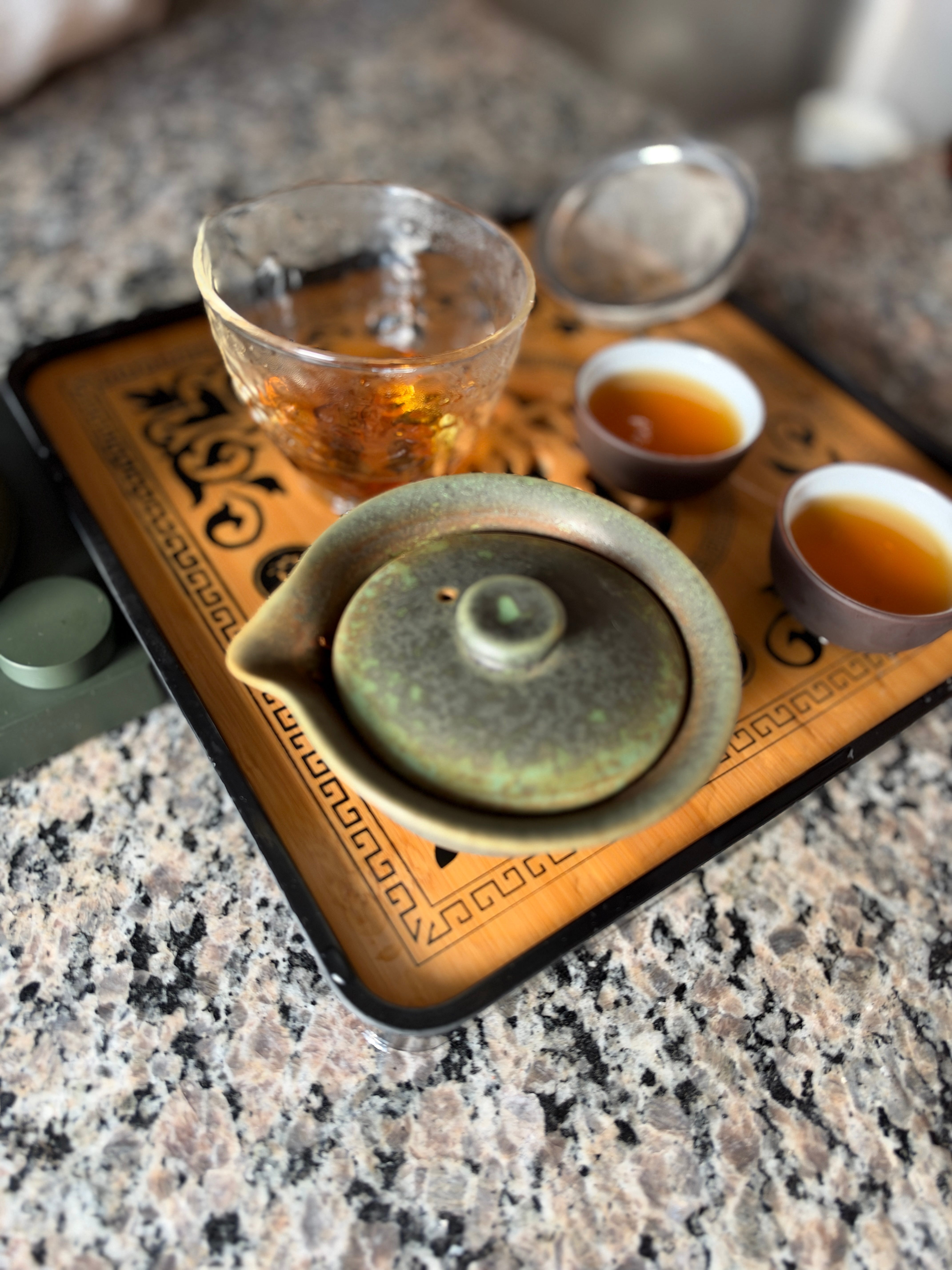
It always strikes me as strange that when I visited my parents, I ended up staying in a hotel. It was easier on them, and maybe I should just admit that it was easier on me. This is the setting for me talking about the tea I call my daily drinker. It was after visits with them, honestly harder visits in their old age, that I’d get back to the hotel room and just need a bit of comfort. (It’s all too common for people to reach for a drink! You know what I mean, right? That was the old me. Haha, the “Day Drinker.“)
But this is about tea, not about your parents getting old and the feelings associated with all of that.
When I travel, I bring this old hotpot-type coil that you just plop in a cup of water. It gets hot as shi%t, and you wait for the water to boil. Seriously, it makes the hotel lights dim! Anyway, what it means is I can have a cup of tea virtually anywhere.
This is when I have my daily drinker, Hao Ya (how yah) B Keemun (kee-mun). My old faithful. What is a daily drinker? It’s that tea that’s not too fancy, is always stocked (ordered in bulk), and is ready for a cuppa. We all need a daily drinker.
Here’s the catch, though. You can’t just magically or randomly just find your daily drinker tea. You have to find it. The hard way. Through experimentation. My daily drinker isn’t your daily drinker. It’s personal.
I was new to tea, and I was way into ordering from Upton Tea. It’s a great shop. I could try everything just to figure it out. The descriptions and tasting notes are lovely. It’s easy to order, and the quality is good. Keemun is a Chinese tea, and Chinese tea is a huge landscape, so I was intimidated. After a few months, I somehow landed on it. Maybe it’s odd, because I had it one evening with milk in it. I’d never do that now, but the milk somehow brought out the underlying flavors, and it really hit me.
Keemun is the old English spelling of Qimen (chee-mun), a county in Anhui (ahn-hway), China. The area made green tea for centuries, then switched to black tea around 1875 as overseas demand grew. Accounts credit Yu Ganchen (yoo gahn-chen) and Hu Yuanlong (hoo ywen-loong).
What it does for me: it’s a pause. It’s the familiarity of a flavor that is different each time.
That’s another great benefit of a daily drinker. It lets you see how a single tea can never be experienced the same way twice. Sometimes it hits perfectly, so you know that’s possible, but you never know when it will happen.
I’m grateful for my daily drinker every time I have it, and grateful just knowing it’s there. There’s a lot to be said for being grateful for something so simple and within reach.
Do you have a daily drinker? If you don’t, you’re lucky too, because you have finding it to look forward to. Once you find it, you’ll know. If you have one, tell me what it is and what it means to you.
Salud!